5 min read
When weekend grime, spiderwebs, and thick coats of seasonal pollen accumulate along your home's exterior, the desire to knock it all out in one afternoon is strong.
Many homeowners—and even well-meaning general lawn or handyman contractors—assume that a commercial pressure washer is an all-in-one exterior tool.
If it blasts grease off a driveway, why not turn the wand toward the windows and blast away the dust?
In reality, mixing up mechanical pressure washing with dedicated window care is one of the quickest ways to cause thousands of dollars in permanent structural and glass damage.
Concrete flatwork requires intense hydraulic force to strip porous soils. Architectural glass, on the other hand, is a delicate precision assembly held together by gas chambers, thin rubber gaskets, and chemical sealants. Blasting glass with high-pressure water doesn't clean it—it puts the entire window system at risk.
Here is the engineering reality behind blown window seals, the chemical truth about soap films, and why pure-water technology is the only safe method for exterior glass.
No. Using a high-pressure washer on residential glass carries extreme risk. High-velocity water strips the protective butyl seals around insulated glass units (IGUs), forcing moisture into the air space between the panes, permanently fogging the glass, and voiding the manufacturer's warranty.
Modern residential homes throughout Wise, Denton, and Parker Counties are built with insulated double-pane or triple-pane windows. These units do not consist of a single sheet of glass clamped into a frame; they are engineered Insulated Glass Units (IGUs).
An IGU features two glass panes separated by an internal spacer bar and sealed along the perimeter with a flexible, airtight polymer compound (usually butyl rubber). The cavity between the panes is filled with inert argon gas to insulate your home from Texas summer heat.
When a pressure washer tip fires water at 2,000 to 4,000 PSI toward a window, several destructive forces take effect:
When homeowners or general contractors try to wash windows using standard pressure washing soap injectors, they routinely use generic house-wash detergents or dish soaps. While soap cuts surface grease, applying it without surgical hand-squeegeeing creates an invisible surface problem.
Everyday cleaning soaps leave behind a microscopic surfactant residue. This film dries completely clear, giving the illusion of cleanliness for about 48 hours.
However, chemical surfactants carry an electrostatic charge:
Professional window care relies on physics and water purification rather than blunt hydraulic force.
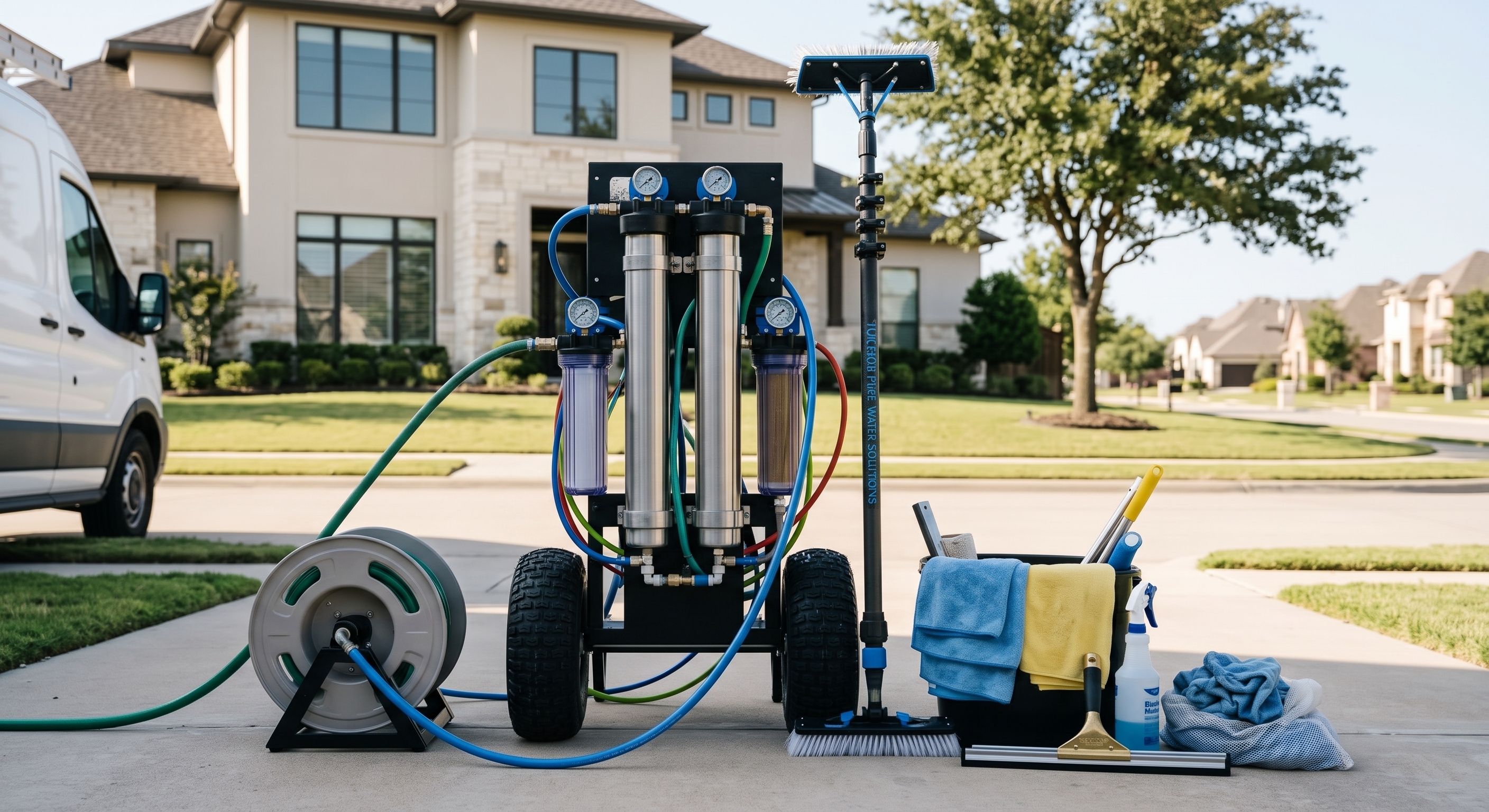
At Wrangler Washers, exterior glass is cleaned using specialized multi-stage Reverse Osmosis and Deionization (RO/DI) filtration carts paired with composite, water-fed carbon-fiber poles.
Tap water contains high concentrations of Total Dissolved Solids (TDS)— dissolved minerals like calcium, magnesium, sodium, and silica. In North Texas, tap water often registers between 150 and 400+ parts per million (PPM) of TDS. If you spray tap water onto glass and let it dry, those minerals remain behind as hard water spots.
The RO/DI system passes water through a sequence of advanced filtration stages:
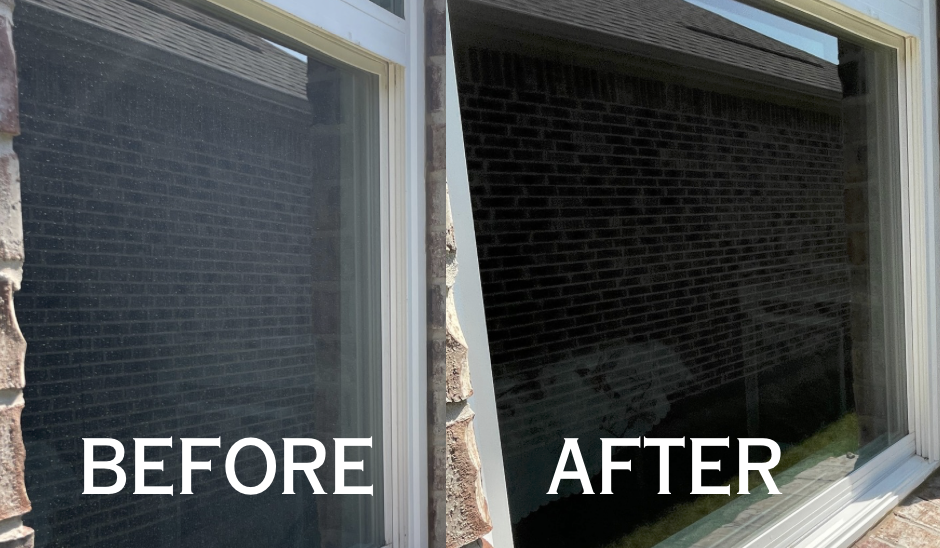
Because 0 PPM pure water is chemically de-mineralized, it acts like a natural solvent. When pumped up a water-fed pole through soft nylon bristles, it dissolves dirt, pollen, and insect spots on contact. When given a final rinse with pure water, the surface is left with zero minerals and zero soap residue. The water droplets evaporate completely into thin air, leaving glass crystal clear without squeegee trails or static charge.
| Feature / Metric | Pressure Washing | Dedicated Pure-Water Window Cleaning |
|---|---|---|
| Operating Pressure | 2,000 to 4,000 PSI | Under 60 PSI (Low, gentle garden-hose pressure) |
| Cleaning Mechanism | Mechanical hydraulic blasting | Mineral-free water solvency + gentle agitation |
| Risk to Window Seals | Severe: High risk of blowing IGU thermal seals | Zero: Pressure is gentle on gaskets and frames |
| Water Chemistry | Untreated tap water (leaves calcium scale) | Laboratory-grade 0 PPM RO/DI deionized water |
| Chemical Additives | Soaps & surfactants (attract dust quickly) | None; zero-residue pure water leaves glass bare |
| Drying Result | Splotchy water spots and soap film | Completely spotless, crystal-clear finish |
Using the right tool for the job is the foundation of smart home maintenance. High pressure is built for stubborn driveway grease, concrete walkways, and patio flatwork—never for your windows.
At Wrangler Washers, we bring dedicated equipment tailored to every surface on your property. Our technicians use commercial rotary surface cleaners for your durable flatwork, and laboratory-grade RO/DI pure-water systems for your windows. That means your window frames remain watertight, your thermal seals stay protected, and your glass stays clean significantly longer.
Protect your home's thermal seals and enjoy true optical clarity across every room.